
Champions League 2026/27 League Phase: Outright & Match Betting Guide
The Champions League returns in September with a format that is very different from the group-stage tournaments of the past. A strong team might open with a match that looks easy on paper, only to face a run of top-tier opponents a few weeks later, followed by a challenging away trip. For bettors, simply looking at the names of two teams in a single fixture isn’t enough anymore. The eight-match schedule of each team is what needs to be studied first.
The 2026/27 season continues with the league phase format of 36 teams. Each club plays eight different opponents, with four home games and four away games. The first matchday runs from September 8 to 10, 2026, while the final matchday is scheduled for January 27, 2027. The opening round already features some heavyweight clashes: Real Madrid vs. Inter, Liverpool vs. Atlético de Madrid, Napoli vs. Arsenal, and Porto vs. Manchester City. These games are exciting but can easily tempt bettors into picking a side based purely on reputation.
This is why analysing Champions League 2026/27 odds should begin with the fixture list, the difficulty of the opponent sequence, and the context of each match, before even looking at the handicap or Over/Under markets. A strong team can still win but fail to cover the spread. Conversely, an underdog doesn’t need to play better than their opponent for 90 minutes to become a viable betting option if the market has overestimated the gap.
Key Points to Remember
- The 2026/27 Champions League features 36 teams, with each club playing eight matches against eight different opponents in the league phase.
- The league phase takes place over 8 matchdays, from September 8, 2026, to January 27, 2027.
- The opening round includes several eye-catching ties like Real Madrid vs. Inter, Liverpool vs. Atlético, Napoli vs. Arsenal, and Porto vs. Manchester City.
- Don't judge a club's fixture list just by the number of big-name opponents; the order of matches, home/away balance, and the domestic schedule surrounding them are equally important.
- Without official odds available for your intended betting time, avoid guessing the handicap. Wait for the market to open and then compare the price with your pre-match assessment.
- For a game where no clear advantage is evident, not betting remains a perfectly sensible option.
When is the 2026/27 Champions League Played?
The league phase begins on September 8, 2026, and concludes on January 27, 2027. UEFA schedules eight matchdays, with the first six rounds completed before the end-of-year break and the final two taking place in January 2027. After this, the competition moves into a play-off round for teams vying for spots in the Round of 16, before proceeding to the knockout stages.
A key difference to remember is that the Champions League no longer uses the familiar four-team group structure. All 36 clubs compete in a single league table, but each team only faces eight opponents. Therefore, the concept of a “Group of Death” in the traditional sense is no longer accurate. Instead, it’s more appropriate to talk about a grueling fixture run or a challenging sequence of opponents for a given club.
|
Matchday |
Dates |
|
MD 1 |
Sep 8–10, 2026 |
|
MD 2 |
Oct 13–14, 2026 |
|
MD 3 |
Oct 20–21, 2026 |
|
MD 4 |
Nov 3–4, 2026 |
|
MD 5 |
Nov 24–25, 2026 |
|
MD 6 |
Dec 8–9, 2026 |
|
MD 7 |
Jan 19–20, 2027 |
|
MD 8 |
Jan 27, 2027 |
The gap between Matchday 1 and Matchday 2 is over a month, but from mid-October onwards, the schedule intensifies significantly. This is a detail bettors need to pay attention to. Reading the Champions League schedule without factoring in the Premier League, La Liga, Serie A, or Bundesliga games nestled in between would be missing a crucial part of the picture.
A team having eight tough opponents doesn’t mean every game will be equally difficult. They might face a big opponent at home with a full-strength squad, but a few weeks later, they could be playing a Champions League away game right after a major domestic fixture. In that context, the opponent’s reputation is just one part of the puzzle.
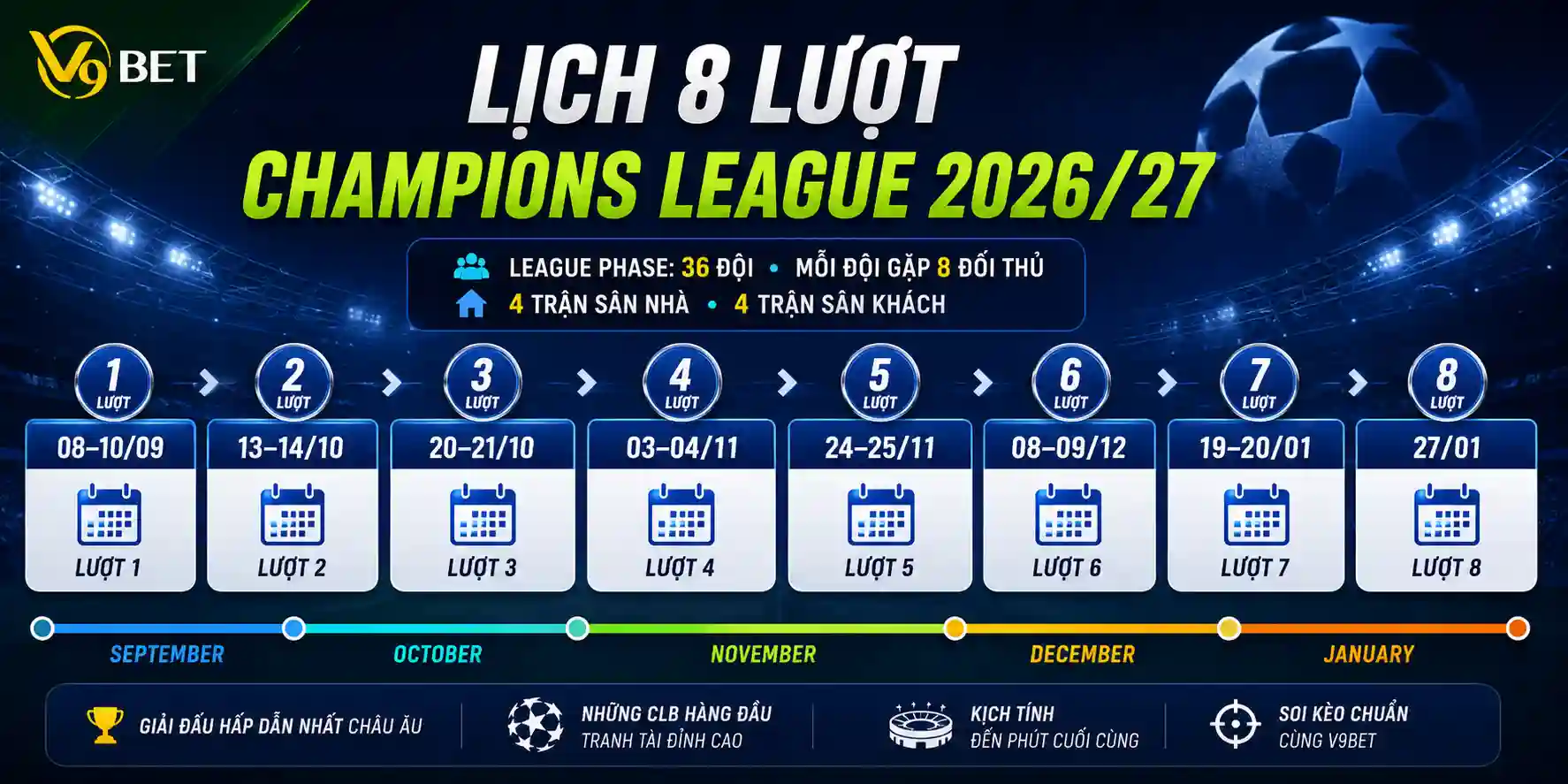
2026/27 Champions League 8-matchday schedule
Matchday 1: Big Clashes Appear as Early as September
Matchday 1 takes place over three days: September 8, 9, and 10. If your goal is to find today’s Champions League betting odds, this round certainly won't disappoint in terms of quality. However, the opening matchday is also a time for caution, as the market often has to price teams when the season is only just getting started.
Some notable fixtures already confirmed by UEFA include:
|
Date |
Notable Fixtures |
|
Sep 8 |
Borussia Dortmund vs. Villarreal |
|
Sep 8 |
Porto vs. Manchester City |
|
Sep 8 |
Real Madrid vs. Inter |
|
Sep 9 |
Liverpool vs. Atlético de Madrid |
|
Sep 9 |
Napoli vs. Arsenal |
|
Sep 10 |
Como vs. Leipzig |
|
Sep 10 |
Bayern München vs. Bodø/Glimt |
|
Sep 10 |
Manchester United vs. Sabah |
In terms of pure spectacle, Real Madrid vs. Inter and Liverpool vs. Atlético will naturally draw the most attention. But the most exciting game to watch isn’t necessarily the easiest one to bet on. When two giants clash, the market is scrutinized closely; information is widely available, interest is high, and very few fundamental factors are truly overlooked.
Napoli vs. Arsenal raises a different question. Arsenal face a tough away trip right at the start, and their schedule later includes Bayern Munich, Borussia Dortmund, and Real Madrid. Just looking at the Napoli game in isolation to judge Arsenal’s chances of going deep could lead to a premature conclusion.
This is why experience from previous seasons should only serve as a reference framework. Those looking to delve deeper into how the Champions League market moves could compare it with the Champions League betting analysis built by V9Bet for last season. However, team data and pricing must be updated for the new campaign.
No More “Groups of Death,” But Some Fixture Lists Are Truly Grueling
The new format makes it obsolete to say a club has been “drawn into a difficult group.” A more relevant question is: who are their eight opponents, where are the toughest games placed, and when do they occur?
Arsenal provides a clear example. The English side start with an away game at Napoli, followed by fixtures against Lille, Bayern Munich, Slavia Praha, Borussia Dortmund, Real Madrid, Real Betis, and Sabah. From late October to early December, Arsenal face Bayern, Dortmund, and Real Madrid, with a trip to Slavia Prague in between.
Manchester City also have a run worth monitoring. They open at Porto, then face Paris Saint-Germain, AEK Athens, travel to Leipzig, host Napoli, and visit Barcelona. The last two games are against Lens and Sporting CP. While the end of their schedule looks lighter, the first six matchdays contain several physically demanding and mentally draining fixtures.
Barcelona will face Manchester City, Paris Saint-Germain, and Aston Villa among their eight opponents. Bayern Munich has Arsenal, Atlético de Madrid, and Manchester United. Liverpool’s league phase journey includes Atlético right away, followed by Villarreal, Fenerbahçe, Porto, and Inter.
|
Team |
Key Challenges in Fixtures |
Observation Points for Betting Analysis |
|
Arsenal |
Napoli, Bayern, Dortmund, Real Madrid |
Sequence of big opponents from October to December |
|
Man City |
Porto, PSG, Napoli, Barcelona |
Many tough games packed into the first six rounds |
|
Barcelona |
PSG, Man City, Aston Villa |
Strong opponents appear in different phases |
|
Bayern |
Arsenal, Atlético, Man United |
Notable away trips |
|
Liverpool |
Atlético, Villarreal, Porto, Inter |
Many experienced European opponents on the schedule |
|
Real Madrid |
Inter, Roma, Arsenal |
Major games interspersed with lower-rated opponents |
This table isn’t an absolute difficulty ranking. By the time each match is played, form, squad availability, and the league phase standings will determine the actual pressure. An away trip to a top opponent on Matchday 2 can be a completely different challenge compared to the same fixture on Matchday 8, when one team might be desperate for points while the other has already secured their objective.
That’s the interesting part of the current format. The difficulty isn’t set in stone from the day of the draw to matchday.
Betting Analysis for Champions League 2026/27 Should Start with the Schedule, Not the Handicap
A common habit is opening the odds board before even starting to think about a match. Doing the opposite is often better: form an opinion first, then see how the market is pricing the game.
Suppose a strong team is about to face a lower-rated opponent. If you just look at the names, you might automatically assume the favourite is the only choice. But before thinking about the handicap, you need to check who the team just played, who they face after the Champions League game, whether this match is home or away, and how many points they need from the league phase.
Once you have that context, the handicap becomes truly meaningful. If the market sets a deep spread for the favourite, the question is no longer “will the stronger team win?” but “do they have the motivation and capability to create a margin that covers the spread?” These two questions sound similar but lead to very different betting decisions.
This is the mistake that causes many bettors to correctly predict the winner but still lose their bet. Real Madrid, Bayern, Barcelona, or Manchester City might win a game, but if the handicap requires a bigger margin than the actual result, picking the strong team isn’t the same as picking the correct bet.
Read the Fixture Run, Not Just the Single Game
The Champions League schedule should be considered alongside the domestic calendar. A team coming off a derby and playing a Champions League game three days later has a different context than a team that had a longer rest. Similarly, a team about to face a direct rival in their domestic league might need to manage their squad rotation carefully.
Don’t jump from a congested schedule to the conclusion that “rotation is certain.” The starting lineup needs to wait for official confirmation. However, match density is still valid data to determine what needs to be checked closer to kick-off.
It is precisely at this stage that analysing the full month’s schedule is far more beneficial than just looking at today’s Champions League odds right before kick-off.
How to Read C1 Handicap Odds When a Big Team Faces an Underdog
The Champions League often creates mismatches on paper. This season, Manchester United faces Sabah on Matchday 1; Paris Saint-Germain hosts Slovan Bratislava; Bayern plays Bodø/Glimt. Such ties easily trigger the mindset that “the big team must win big.”
But the handicap isn’t asking who is stronger. It asks what level of disparity the market has already priced in.
If a favourite is priced at a deep handicap, backers of the favourite need a more specific scenario than just ball possession and a win. They need a sufficient margin. An early goal can open a game up, but there are also cases where a strong team takes the lead and then eases off, prioritising control over continuing to attack at high intensity.
Conversely, the underdog doesn’t automatically become a good bet just because they are getting a big head start. If they can’t escape the press, keep losing possession near their box, or have no means to push the game out of their own half, a large handicap might still accurately reflect the gap.
|
Situation |
Question to Ask |
Common Mistake |
|
Big team with a deep handicap |
Is a big win necessary? |
Picking the favourite based on name alone |
|
Favourite playing away |
Does their control of the game change? |
Treating home and away strength as equal |
|
Underdog sitting deep |
Can they withstand sustained pressure? |
Assuming a packed defence is automatically a good one |
|
Favourite takes an early lead |
Will the attacking intensity continue? |
Adding to the bet just because of the opening goal |
|
Game is 0-0 longer than expected |
Is the game truly stuck or just missing a goal? |
Rushing to switch to the underdog |
One of the most useful V9Bet betting tips is actually quite simple: don’t let liking a team become the reason to like every handicap associated with that team. If the price changes, the equation changes.
Champions League Over/Under: Don’t Just Count Attacking Stars and Pick Over
When two strong teams meet, backing Over often feels like the natural choice. Bettors look at the attack, remember previous high-scoring games, and picture a goal-fest. But high attacking quality doesn’t automatically produce a high-scoring match.
Real Madrid vs. Inter on Matchday 1 is the kind of game where you need to understand the tactical setup before drawing conclusions. The same goes for Liverpool vs. Atlético. The names are big enough to create expectations, but how the two teams approach the game, the state of the scoreline, and their conversion efficiency will directly affect the total goals.
When the official odds appear, don’t just ask if the Over/Under line is high or low. Ask what kind of game the market is anticipating. If the total goals line already heavily reflects the attacking strength of both sides, an Over bettor needs an additional reason to believe the game can beat that expectation.
Live betting can sometimes provide data that the pre-match market didn’t have. A 0-0 scoreline after 20 minutes doesn’t necessarily mean the game is trending Under if both sides are consistently breaking the press, creating clear chances, and the keepers are active. Conversely, an early 1-0 doesn’t guarantee Over if the goal came from a set-piece or isolated moment and the game immediately slows down.
This is where watching the game matters more than looking at the odds board in isolation.
Corner and Card Markets Could Be Worth Watching More Than the Match Outcome
Balanced games often make Asian handicaps tricky, but that doesn’t mean you should completely ignore the match. Corners and cards are two markets that can reflect other aspects of the game, as long as you understand what data you’re looking for.
For corners, don’t assume that an attacking team will always earn more corners. You need to see how they get the ball into the final third. A side that constantly uses the wings and plays crosses from the byline will generate corners differently than a team that prefers central combinations and direct passes into the box.
Card markets depend heavily on the nature of the matchup, pressing style, and situations requiring fouls to stop counter-attacks. A team with less possession won’t necessarily pick up more cards; the key is where they lose control and how they handle transition moments.
For both markets, team news and how the game starts should be updated as close to kick-off as possible. Don’t take an old average and apply it blindly to every Champions League match.
Pre-Match or Live Betting: Which is Better for the UCL?
There is no default better option. Pre-match offers more time to study the schedule, lineups, and context; live provides actual on-pitch data but requires quicker processing.
Bettors with a clear view on how the two teams will start can prepare a pre-match market. Those uncertain about the lineup, pressing intensity, or the favourite’s attitude can afford to wait. Waiting isn’t about missing an opportunity. Sometimes, the first five or ten minutes provide more information than hours of looking at team names.
|
Criteria |
Pre-Match |
Live Betting |
|
Time for analysis |
More |
Less |
|
Actual match data |
Not available |
Available |
|
Odds fluctuation |
Usually less sudden |
Can change quickly |
|
Bankroll management |
Easier to plan |
Requires more discipline |
|
Risk of emotional decisions |
Possible |
Higher when the game is fast-paced |
|
Best when |
Your assessment is clear |
You need to confirm the flow of the game |
A common mistake is using live betting to salvage a losing pre-match ticket. These two decisions should be treated separately. If you backed the favourite pre-match and they’re playing poorly, adding more money on the favourite just to “get it back” doesn’t create new data to prove the original pick was right.
If the actual game flow contradicts your initial assessment, accepting a losing bet is often more sensible than trying to defend it with more money.
Those following multiple matches simultaneously can check BTi Sports or SABA Sports on V9Bet to see what markets are available. The focus should still be on the markets you prepared beforehand, rather than seeing more options and spawning extra bets.
Champions League Outright Odds Should Be Read Differently Than Match Odds
Champions League outright odds present a long-term puzzle. A team can lose one or two league phase games without their chances of going deep being completely over; conversely, hammering a few weaker opponents doesn’t prove they are the best candidate for the title.
The 36-team format makes this clearer. The league phase schedules aren’t identical, so the standings after a few rounds need to be weighed against the difficulty of opponents faced. Two clubs with similar points totals might have had very different journeys to get there.
To assess outright odds, you should separate at least three layers. The first layer is the team’s actual strength. The second is their ability to navigate the league phase for a favourable position. The final layer is their suitability for two-legged knockout ties, where one mistake can change a whole season.
The price matters too. “The team most likely to win the title” and “the most attractively priced option” aren’t always the same. If the market has already made a candidate a very clear favourite, the edge from your assessment might already be reflected in the odds.
Therefore, outright bets shouldn’t be placed just because you saw a team win big at the weekend.
Three Fixture Types That Trap UCL Bettors
The first is a big team vs. a lesser-known side. The names create an emotional disparity even before the odds board appears. Bettors often ask how many goals the favourite will win by rather than what handicap is reasonable. This reversal of questions turns a correct football opinion into a bad betting choice.
The second type is a blockbuster between two major brands. The more famous the game, the more it feels like you must have a bet on it. In reality, these are usually the most heavily analysed matches, the market reacts quickly to news, and it’s very hard to find an edge using only the data everyone else knows.
The final type is a match played when the league phase table starts to take shape. One team needs to win; the other needs to avoid defeat or already has a relatively comfortable position. At that point, the team’s season-long form might not be as important as their specific objective for that 90 minutes.
This factor becomes more relevant from Matchday 7 and 8 onwards. The final round has 18 games kicking off simultaneously, so the standings situation can change while the match is in progress. Live betting in that scenario requires reading both the score of the game you’re watching and the results directly impacting the two teams’ positions.
Betting on UCL at V9Bet: Prepare Your Markets Before the Odds Open
A practical approach is to narrow down your options beforehand. If you’ve determined you only understand handicaps and Over/Under well, there’s no reason to switch to a less familiar market just because the Champions League offers many betting options.
Before kick-off, you can prepare two or three scenarios. If the favourite starts with a strong lineup and the handicap falls within a range you consider reasonable, then proceed. If the price is pushed further than expected, skip it. If you’re still unsure about how the game will start, wait for live betting.
This method avoids a common mistake in V9Bet UCL betting: opening the sportsbook first and letting the board decide what you will analyse. Long-time bettors usually don’t lack options. What’s harder is limiting the number of decisions.
Suppose your bankroll for the entire night is 1,000,000 VND. Splitting that limit across matches beforehand helps prevent an early losing ticket from increasing your stake on the next game. The exact number depends on each individual’s bankroll; the important principle is not letting the outcome of one bet automatically change the risk level set for the next.
If three games at the same time all show no clear edge, you don’t need to pick all three. One is fine. Even none is fine.
Which Fixtures Should Be Marked Early?
Instead of trying to memorise all 144 league phase matches, bettors can mark the high-value ties and update their data as the game approaches. This is more practical than trying to analyse everything from the start of the season.
Arsenal have a run of Bayern Munich, Borussia Dortmund, and Real Madrid from late October to early December, with other opponents in between those big games. Manchester City face PSG in October, Napoli in November, and Barcelona in December. Barcelona meet PSG on October 20 and then Man City on December 8. Real Madrid open with Inter and travel to Arsenal on December 9.
These games are worth noting in the calendar, but they aren’t betting signals yet. There’s enough time between now and kick-off for form, personnel, and league phase positions to change. A good betting analysis updated close to the game is always more valuable than a static opinion from weeks before.
If you want to see how a Champions League game between top sides was broken down layer by layer, the piece on PSG vs. Arsenal in the Champions League can serve as a reference for analytical structure. Naturally, data from previous seasons shouldn’t be carried over directly to the 2026/27 campaign.
When Should You Wait for Live Betting Instead of Going Pre-Match?
Waiting for live betting makes sense when your biggest question can only be answered after the opening whistle. For example, is the favourite really pressing high? Can the underdog escape the first wave of pressure? Is a team actively pushing their full-backs high as expected, or are they keeping a safer structure?
If these factors determine your choice, betting pre-match means accepting a degree of unknown information.
However, live betting has its own traps. A team pinning the opposition back for five minutes can easily create the feeling a goal is imminent. If most attacks end in sideways passes, long shots, or aimless crosses, the actual danger might be lower than the visual impression.
The scoreline can also be deceptive. A team trailing 0-1 isn’t necessarily playing badly; a team leading 1-0 isn’t necessarily in control. Live bettors need to distinguish between the result on the scoreboard and the quality of the performance.
And if you can’t follow closely enough, a small-stake pre-match bet might be more suitable than trying to process constant live changes.
Bankroll Management Is More Important Than Finding Every UCL Game Each Night
The Champions League has many games in the same time slot. This is an advantage in terms of choice but also a source of overload. When three or four attractive matches are on simultaneously, bettors can feel like they’re missing out by not betting on each one.
You don’t need to.
Suppose you’ve prepared three games but only one has a price that fits your analysis. Only placing one bet doesn’t make your analysis a failure. On the contrary, it shows you’re letting the market price determine whether an opinion is worth turning into a bet.
After a losing bet, don’t automatically increase your stake on the next one. The Champions League runs from September to January just for the league phase; there’s no reason to turn one match night into a must-win situation to recover everything immediately.
Similarly, winning the first two bets doesn’t make the third one safer. Each decision needs to be evaluated on its own merits.
Frequently Asked Questions
When does the 2026/27 Champions League start?
The 2026/27 Champions League league phase begins on September 8, 2026, with the first matchday running until September 10. This phase consists of eight matchdays, ending on January 27, 2027. After the league phase, the competition moves into the play-off and knockout rounds before the final on June 5, 2027, in Madrid.
Does the 2026/27 Champions League still use four-team groups?
No. The 2026/27 season continues with the league phase format featuring 36 clubs. Each team plays eight different opponents, with four home games and four away games. Therefore, the term "Group of Death" from the old format is no longer accurate; the difficulty should be assessed based on the eight opponents and the fixture order for each club.
Which matches are notable in the opening round of the Champions League?
The first matchday features Real Madrid vs. Inter, Porto vs. Manchester City, and Borussia Dortmund vs. Villarreal on September 8; Liverpool vs. Atlético de Madrid and Napoli vs. Arsenal on September 9. These ties are worth monitoring from a footballing perspective, but a match's appeal does not mean the betting odds will be easy to navigate.
Should I choose Asian Handicap or Over/Under when analysing the UCL?
There is no inherently better market. Asian Handicap is suitable when you have a clear assessment of the relative strength and the potential for a margin of victory. Over/Under requires reading how both teams create chances, the tempo of the game, and the total goals line set by the market. If you lack a strong basis for either, waiting for live betting or skipping the match are both valid options.
Should I bet on every Champions League game I watch?
Not necessarily. Watching a match and having a betting edge are two different things. Famous blockbusters are often great to watch but difficult to find value in. Selecting fewer games helps you focus on the data and maintain a steadier bankroll on a night with many simultaneous matches.
Where can I follow UCL odds on V9Bet?
Players can check the sports markets offered through BTi Sports or SABA Sports. Markets and odds can change, so it's best to check directly close to the match time rather than using old odds from a preview article.
Expert Conclusion
The difficulty of analysing Champions League 2026/27 odds does not lie in a lack of information. On the contrary, bettors are presented with too many matches, too many markets, and too many top teams to choose from. The 36-team format further highlights the insufficiency of looking at individual games in isolation: the eight opponents, the order of fixtures, home and away balance, and the league phase standings can all change the meaning of a single match.
Right from the opening round, Real Madrid vs. Inter, Liverpool vs. Atlético, Napoli vs. Arsenal, or Porto vs. Manchester City are enough to draw attention to the big names. However, don't let the team names replace reading the price. The stronger team can win but fail to cover the handicap; a match between two strong attacks can still stay under the total goals line.
A sensible approach is to form an assessment beforehand, wait for the official odds, and then see if the price fits. With live betting, only enter when the actual match flow adds valuable information, not as a way to recover a losing pre-match ticket.
The Champions League spans many months. There is no need to win a season's worth of bets in one night. When the handicap doesn't seem right, the data is contradictory, or you simply don't see an edge, closing the odds board and just watching the football is also a good decision.